Soil Stabilization & Grouting for Florida Seawalls
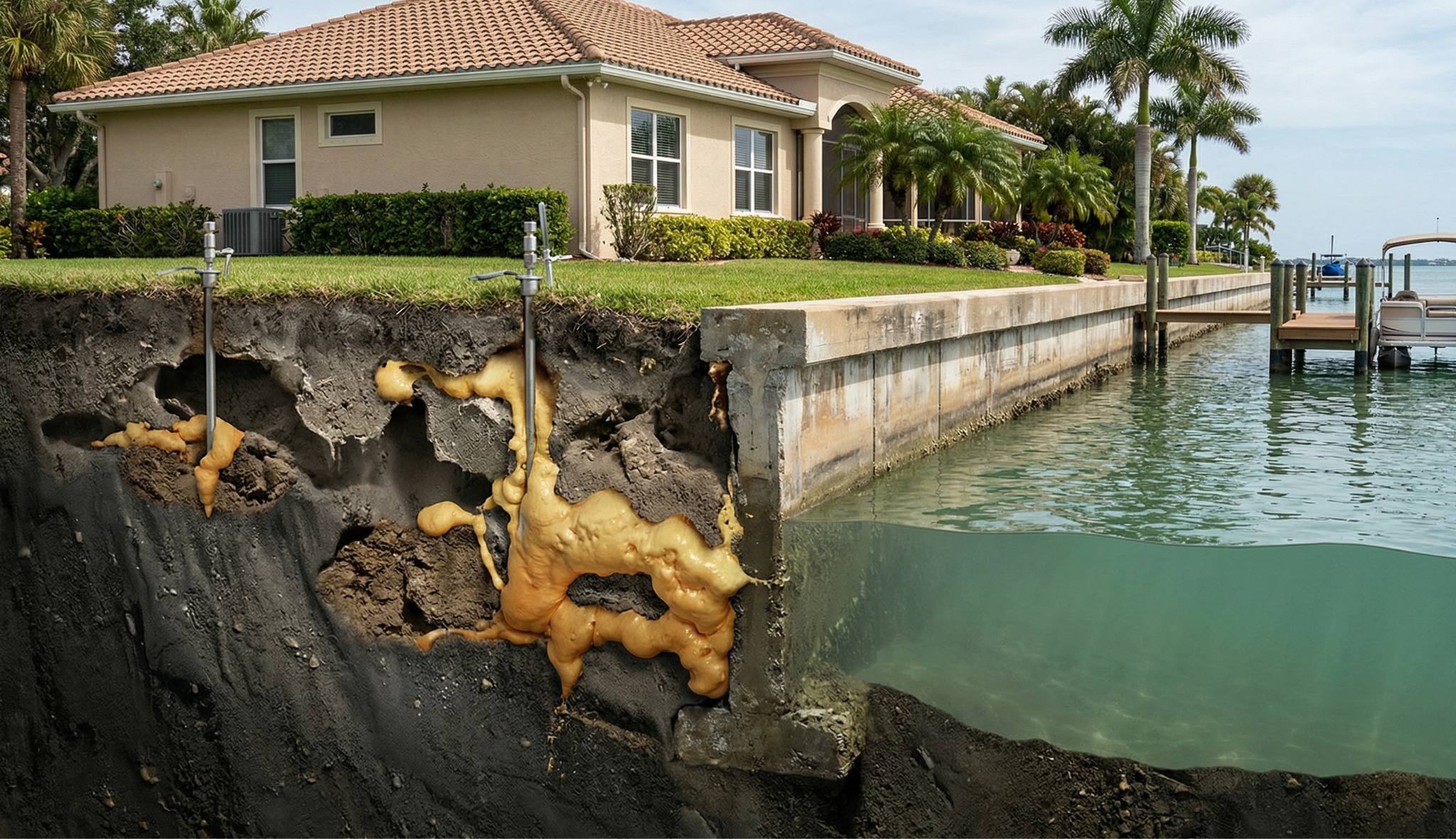
Your seawall itself is only part of the equation. What lies behind it, the soil your seawall was built to protect, is equally critical to its structural integrity. When that soil erodes, shifts, or develops voids, the entire system is at risk.
Soil stabilization is the structural backbone of effective seawall repair. We provide soil stabilization services tailored to the specific demands of Florida’s marine environment, including sandy soils, tidal pressures, and storm exposure. Our experienced team reinforces the ground behind your seawall before failure becomes irreversible.
What Is Soil Stabilization?
- Structural reinforcement of loose, saturated, or eroded soils behind a seawall
- Prevents underground void formation that leads to wall movement and collapse
- Extends the functional life of existing marine structures without full replacement
When Are Soil Stabilization Services Needed?
- Visible sinkholes, surface dips, or soil washout near the wall
- Seawall panels that are cracking, bowing, or leaning
- Dock or slab settlement on waterfront property
- Post-hurricane marine soil erosion and storm surge damage
Why Soil Failure Happens Behind Seawalls in Florida
Florida’s coastal soils are sandy and highly permeable. They drain quickly and erode easily. That’s a significant liability for any waterfront structure. Several forces work against your seawall daily:
- Tidal fluctuation repeatedly saturates and drains the soil, weakening its structure over time
- Heavy rainfall increases hydrostatic pressure behind the wall, pushing water through any available gap
- Storm surge carries soil away rapidly, creating voids that aren’t visible from the surface
- Poor or aging drainage traps water behind the wall and accelerates deterioration
- Aging bulkhead systems develop cracks and failed seams that allow soil to migrate out with each tidal cycle
Left unaddressed, these conditions create underground voids that grow silently until the wall begins to shift, crack, or collapse.
Seawall Soil Stabilization Methods We Use
We deploy the right solution based on your wall’s condition, soil type, and structural load. In many cases, we combine methods for complete reinforcement.
Polyurethane Grouting (Void Filling & Compaction)
Polyurethane grouting is our primary tool for addressing soil washout and underground voids behind seawalls. We inject a high-density, expanding structural foam through small-diameter ports drilled into the ground: no excavation required.
The foam expands to completely fill voids, compacts loose surrounding soil, and cures rapidly into a lightweight, water-resistant mass with high compressive strength. Work is typically completed in a single day with minimal disruption to your property.
This approach, sometimes called polyjacking, is far superior to traditional mudjacking in marine environments. Polyurethane is lightweight (avoiding additional load on compromised soil), water-resistant, and durable in wet, saltwater-adjacent conditions where a heavy slurry would fail or wash out.
Helical Tiebacks
When a seawall is bowing outward or leaning from hydrostatic pressure, grouting alone isn’t sufficient. Helical tiebacks mechanically anchor the wall back into stable soil layers below the zone of erosion, providing long-term lateral resistance.
This is an engineered solution appropriate for high-load walls, walls with significant deflection, and commercial or municipal structures with strict structural performance requirements. We coordinate with licensed engineers on tieback projects as needed.
Deadman Anchors
Deadman anchors provide lateral stabilization by connecting the seawall to a buried anchor mass set back into the property. They are a proven, cost-effective option for walls where tiebacks aren’t feasible due to site constraints or soil conditions.
Compared to helical tiebacks, deadman systems require more excavation and are better suited to new construction or major repairs where site access permits proper installation. We’ll recommend the right anchoring approach after evaluating your wall’s condition and your property’s layout.
Polyjacking vs. Mudjacking in Marine Environments
Not all grouting methods are equally effective, especially in saltwater environments. Here’s how polyurethane grouting compares to traditional mudjacking:
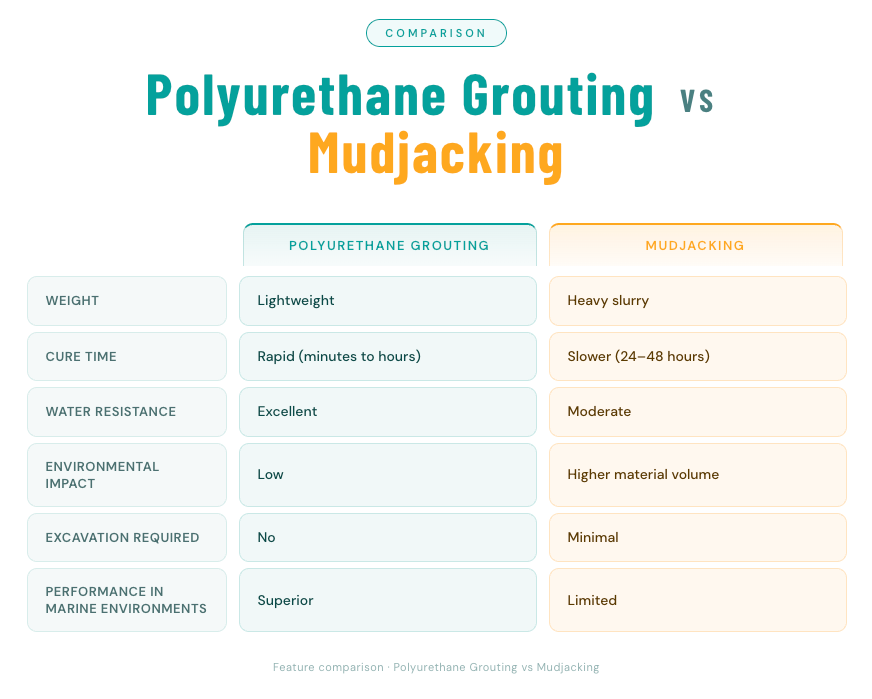
For seawall applications, polyurethane is the clear choice. A heavy mudjacking slurry adds load to already-compromised soil and can wash out in high-moisture or tidal environments. Polyurethane fills voids precisely, bonds to surrounding material, and holds up in conditions that would degrade a cement-based slurry.
Commercial & Municipal Seawall Soil Stabilization Projects
Soil instability behind a seawall isn’t just a residential problem. HOAs with shared waterfronts, marinas, municipalities, and commercial waterfront properties face the same risks, often on a greater scale and with more at stake, structurally and financially.
We have experience managing large-scale soil stabilization projects that require coordination with structural engineers, local permitting authorities, and property managers. Our team understands the documentation, scheduling, and communication standards that commercial and municipal clients expect.
Whether you’re managing a marina with aging bulkheads, a multi-unit waterfront development, or a municipal seawall serving a public area, we have the capacity and experience to handle it.
We’re fully licensed (License #CBC 1265946) and prepared to support projects that require engineering sign-off and formal reporting.
When Soil Stabilization Is Better Than Full Seawall Replacement
Replacement is sometimes necessary, but it’s often not. Many seawalls that appear to be at the end of their life are structurally sound and simply suffering from soil failure behind them. Stabilizing the soil addresses the root cause without the cost, disruption, and timeline of a full demolition and rebuild.
In the right situation, soil stabilization can:
- Restore structural performance at a fraction of replacement cost
- Be completed in days rather than weeks
- Carry a strong warranty on materials and workmanship
- Buy decades of additional service life from an existing wall
We’ll give you an honest evaluation of your wall and tell you directly whether repair and stabilization are viable or whether replacement is the better long-term investment. Learn more about our seawall repair services or explore new seawall construction options.
Schedule a Structural Evaluation to find out where your wall stands.